Life After Stroke

Stroke Recovery and Rehabilitation

Stroke Recovery and Rehabilitation

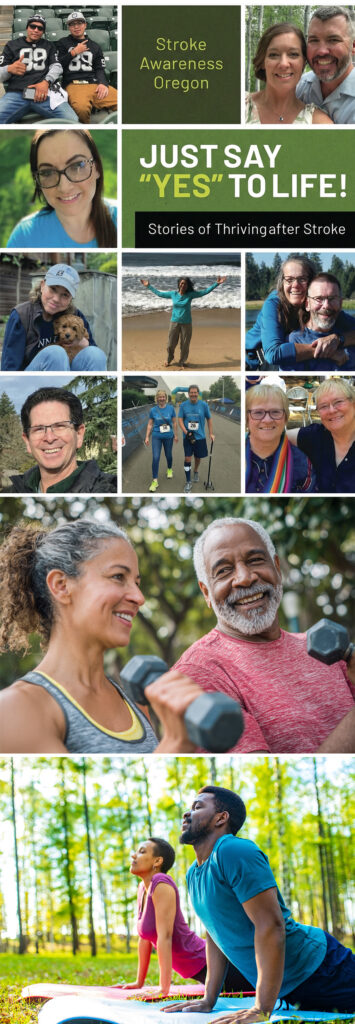
Find inspiration and hope in our Amazon best-selling novel, Just Say “Yes” to Life! It’s an enlightening piece of literature that has 26 stroke survivor stories from around the world.

Stroke Awareness Oregon— In Just Say “Yes” to Life, Vol. 1, a collection of stories about surviving and thriving after stroke, people from all over the U.S. tell it like it is about the tragedies and triumphs they experienced after stroke. They speak with candor about their worst days, their grit and resilience, and the profound contentment and unexpected bursts of enthusiasm they feel for life today.

Written to give solace to current survivors, the 26 stories in Just Say “Yes” to Life! detail how these survivors coped, and which therapies helped them most. Readers will be inspired by a Bend teenager who rebounded well enough to enroll in college a few years after his stroke, a Bay-area physician who reinvented herself as a writer and performer, and a Bend forester who created a chair the world’s never seen before, one that allows those who use wheelchairs to navigate rugged wilderness terrain. Authentic, vulnerable, and brave, the tales give stroke survivors, and those who love them, hope for the best possible recovery and encourage them to never give up!

The best way to begin your road to recovery is to start getting educated about the resources that are available to you.

In the beginning, you and your doctor and physical therapist will address your individual diagnosis. Once you and your medical team determine the type of rehabilitation regimen you will require, you can begin to research the “best practices” associated with your recommended rehabilitation protocol.

The purpose of recovery and rehabilitation is to retrain functions that were lost or impaired due to brain injury caused by a stroke.

There are both health concerns and rehabilitation protocol to be considered.

“Our whole world changed after my stroke. Friends stopped coming around, we stopped going out, and we both got really depressed”

— Stroke Warrior

When patients leave the hospital or inpatient rehab following a stroke, there is no comprehensive guide recommending resources, what to expect, or what to do next. This leads to a tremendous burden on the spouse or caregiver, and isolation of the family and stroke survivor. Often, stroke survivors become depressed and ‘give up’ or are simply afraid to get out and try things.

You may ask, “How long should I do rehab?” There are differing opinions. You may be told to expect no changes after the first 12 months. Or you may be told not to bother with rehab. The truth is the brain has plasticity and an amazing capacity to heal itself. There are stroke survivors who continue rehab and improve for years after their stroke. Suffering a stroke does not mean the end of living but it can mean a new reality.

During COVID-19 physical distancing, we are meeting virtually on Zoom. Here’s a cheat sheet on how to download Zoom and attend a meeting.

Interested in Support Groups? Read Below.

Some of these questions don’t have easy answers, but the single most important thing to remember is to never lose hope and never stop trying to improve.

New therapies are always being discovered and patients who are dedicated often experience drastic improvement. Many questions include:

  • Am I going to get better?
  • How long does rehabilitation take for my particular situation?
  • Are there ways to speed up my recovery?

Health concerns include but are not limited to:

  • Assessment and degree of damage done by the stroke
  • Type and severity of injury to upper and lower extremities
  • Assessment of cognitive function, speech impairment and possible problem swallowing (dysphagia)
  • Issue with posture, walking and balance
  • Sensory disturbances including pain, tingling and numbness
  • Damage to sense of touch or to determine temperature, inability to recognize objects or their own body parts
  • Chronic pain syndrome caused by immobility (frozen joint)
  • Loss of bladder control and bowel control caused by inability to move normally
  • Problems using or understanding language (aphasia)
  • Problems with the ability to write and read
  • Problems with memory or the proper arrangement of thoughts, shortened attention span and issues with short term memory also can occur
  • Mental health issues, anxiety, depression, helplessness and anger can all occur after a stroke. Counseling and medication may be necessary to mitigate these common maladies associated with stroke
  • If you’ve had a stroke there is a 23% chance you will suffer a second stroke which is why it is imperative to work with your physician to mitigate stroke risk
As you can see, it is critical to complete a thorough diagnosis after a stroke to determine exactly which health issues require rehabilitation.

Once the determination is made, a rehabilitation protocol can be developed with the patient and their medical team. The Stroke Rehabilitation Team is often made up of specialists uniquely qualified to help improve the patient’s specific condition.

Physicians

The primary physician will continuously diagnose and treat any medical issues as well as prescribing the appropriate medications.  The physician will also recommend specialists including neurologists, internists, geriatricians, physical therapists and more.

Other professionals will also be considered based on the needs of the patient.  As the patient progresses through the stages of rehabilitation, new medical professionals may be introduced as needed.

Psychologists  |  Physical Therapists  | Speech and Language Therapists  |  Occupational Therapists | Vocational Therapists  

Types of Rehabilitation

  • Inpatient Rehabilitation – Full-service rehabilitation at designated facility, typically fully staffed with physicians, physical therapists and rehabilitation specialists. These facilities typically have a full range of rehabilitation equipment including specialized diagnostic equipment, etc. This type of facility provides important rehabilitation daily and can last anywhere from one to six weeks depending on the type of rehabilitation the patient requires
  • Outpatient Rehabilitation – Outpatient facilities are often attached to hospitals or large medical facilities. They offer the same or similar services as inpatient facilities, but the patient is typically given a weekly outpatient rehab schedule to follow. The outpatient facilities are usually staffed with qualified physicians, therapists and specialists trained to provide service to patients
  • Skilled Nursing Facilities – These facilities are usually staffed by skilled medical professionals who specialize in physical therapy. The patient will visit the facility and focus on specific rehabilitation geared toward their particular medical issues
  • Home-Based Rehabilitation Programs – The home-based rehabilitation programs involve a trained physical therapist coming to the home providing great flexibility to the patient. The therapist will work on a variety of rehabilitation exercises based on the patient’s immediate needs. Things like walking, mobility, balance and at home tasks can all be enhanced with in-home therapy
  • Tele-health – Tele-health increased dramatically with the COVID-19 pandemic incident. Physicians, therapists and patients can now stay connected and share valuable updates and information related to a patient’s progress in stroke rehabilitation

Questions to ask your Speech-Language Pathologist

(Overland Speech and Swallowing Rehabilitation)

Did you know it’s okay to interview your new therapist? Even encouraged.
Check out these tips on questions to ask to make sure you find the right SLP for your needs.

Technology Applications in Stroke Rehabilitation

  • Treadmill/Stopwatch – one of the most basic and useful forms of technology is the treadmill and the stopwatch. It’s critically important to measure results and set timelines and goals for incremental improvement in rehabilitation protocols. Some therapies take longer or are effective shorter term, but technology can improve the assisted results in a rehabilitation regimen
  • Brain Stimulation – Direct current stimulation using transcranial direct current is designed to stimulate the brain and improve function of the extremities
  • Biofeedback – Various forms of biofeedback technologies and vibration technologies are being tested to assist in rehabilitation of both the upper and lower extremities
  • Telehealth – Telehealth uses both audio and video technology to create a valuable feedback loop between physicians and their patients in real time. This technology will grow and become a normal part of rehabilitation treatment in the future

Friendship Line

Offers support for Central Oregon Seniors who find connecting with the community challenging

TOLL FREE: 800-971-0016

Institute on Aging’s 24-hour toll-free Friendship Line is the only accredited crisis line in the country for people aged 60 years and older, and adults living with disabilities. We also make ongoing outreach calls to lonely older adults. While there are other organizations that respond to the needs of people who may be contemplating suicide, none provides the type of services that IOA’s Friendship Line offers to respond to the public health problem of suicide among the elderly. Knowing that older people do not contact traditional suicide prevention centers on a regular basis even if they are considering suicide, we created the only program nationwide that reaches out to lonely, depressed, isolated, frail and/or suicidal older adults. Our trained volunteers specialize in offering a caring ear and having a friendly conversation with depressed older adults.

The Golden Rules

for Maximizing Stroke Recovery (From Strokemark)

The long and arduous process of rehabilitation begins immediately after a stroke. But where should you get started with your stroke recovery and what are the most important things for you to know? Under each rule, you will find links to Strokemark articles that offer more detailed information.

1. Think and act like a professional athlete
2. Provide the right conditions to recover
3. Improve your concentration
4. Improve the adaptive capacity of your brain
5. Improve your strength

6. Make your heart work
7. Avoid unnecessary movements
8. Train often and for long periods of time
9. Don’t get frustrated
10. Don’t give up!

Your Donation Can Save a Life & Enhance
the Recovery of a Stroke Warrior!

SAO Contact

Thank you for your interest in Stroke Awareness Oregon! We look forward to connecting with you further. You can reach the SAO team by phone, email, or in-person at the SAO office in Bend, Oregon. If you or a loved one are displaying signs of stroke please Call 9-1-1 immediately. Time = Brain!


    Become a STROKE CHAMPION for only $18 per month!

    Story Preview | A DRIVING FORCE – Alesha Goodman

    by Jake Sheaffer

    “I once threw a canister of my supplement powder at the wall and dented it. That’s something I can’t imagine ever doing before my stroke, but it’s just another part
of my recovery to work on.”

    ______________________________

    On an early October weekend in 2019, Alesha Goodman and her longtime boyfriend Drew hiked over 50 miles of rugged desert landscape in the Ochoco National Forest in Central Oregon. They were on a nine-day hunting trip they’d been planning for months. While Drew streaked up the steep slopes of sagebrush and loose rock, Alesha tarried behind breathing heavily, fighting the searing pain radiating from the base of her skull. An active thirty-four-year-old who frequented local gyms, walked her dog daily, and hiked on weekends, Alesha never suspected the severe neck pain and nausea she’d had for the past week and a half were signs of an impending stroke. And not just one stroke, but two. Two potentially fatal strokes that would occur within an hour of each other the day after she returned from the Ochocos.

    An only child, Alesha was close to her parents and her grandmother who lived on her parents’ property later in life. As a kid, she delivered newspapers in her Bend, OR neighborhood, and in her spare time, she wrote children’s books for fun and read voraciously, prompting close friends to refer to her as a “living encyclopedia of odd information.”

    On the Monday morning after she got home, Alesha sat in traffic at a parkway off -ramp, still in discomfort from the neck pain and the nausea. She had new symptoms, too, dizziness and feeling faint. Regardless of the pain, she readied herself for work, but she had an uneasy feeling about her job.

    Over the weekend, Alesha had received multiple text messages from her employer, a jewelry company in Central Oregon, about an issue with her company email and password, but with no cell reception, she couldn’t respond to her manager’s concerns. After searching through Alesha’s desk for her email password and not finding it, but instead finding an important legal document she’d already dealt with but had not yet disclosed to her boss, the company hired a specialist to get around the digital safeguards. That day, Alesha was let go from her position.

    Purchase the Book to Learn More About Alesha’s Journey!